World
Nomad
Games
A global celebration of nomadic heritage — uniting athletes, artists, and cultures from over 89 nations through the living traditions of the steppe.
Every two years, the worlds nomadic peoples gather to compete in ancient sports, perform epic poetry, share cuisine and craft, and demonstrate that the spirit of the nomad is not a relic of the past — but a vital, enduring force in the present.
A story forged in the steppes
For millennia, nomadic peoples shaped civilizations across Eurasia — building empires on horseback, carrying culture through song and oral tradition, sustaining communities across the harshest landscapes on earth.
The World Nomad Games was born from a simple but profound idea: that this heritage deserved a global stage. In 2012, Kyrgyzstan's President Almazbek Atambayev proposed an international festival dedicated to preserving and celebrating the traditions of nomadic peoples worldwide.
The first edition opened in 2014 on the shores of Lake Issyk-Kul with 19 countries and 600 athletes. By 2018, 77 nations were participating. By 2023, 89 countries had sent delegations — making it one of the most internationally diverse cultural-sporting events on the planet.
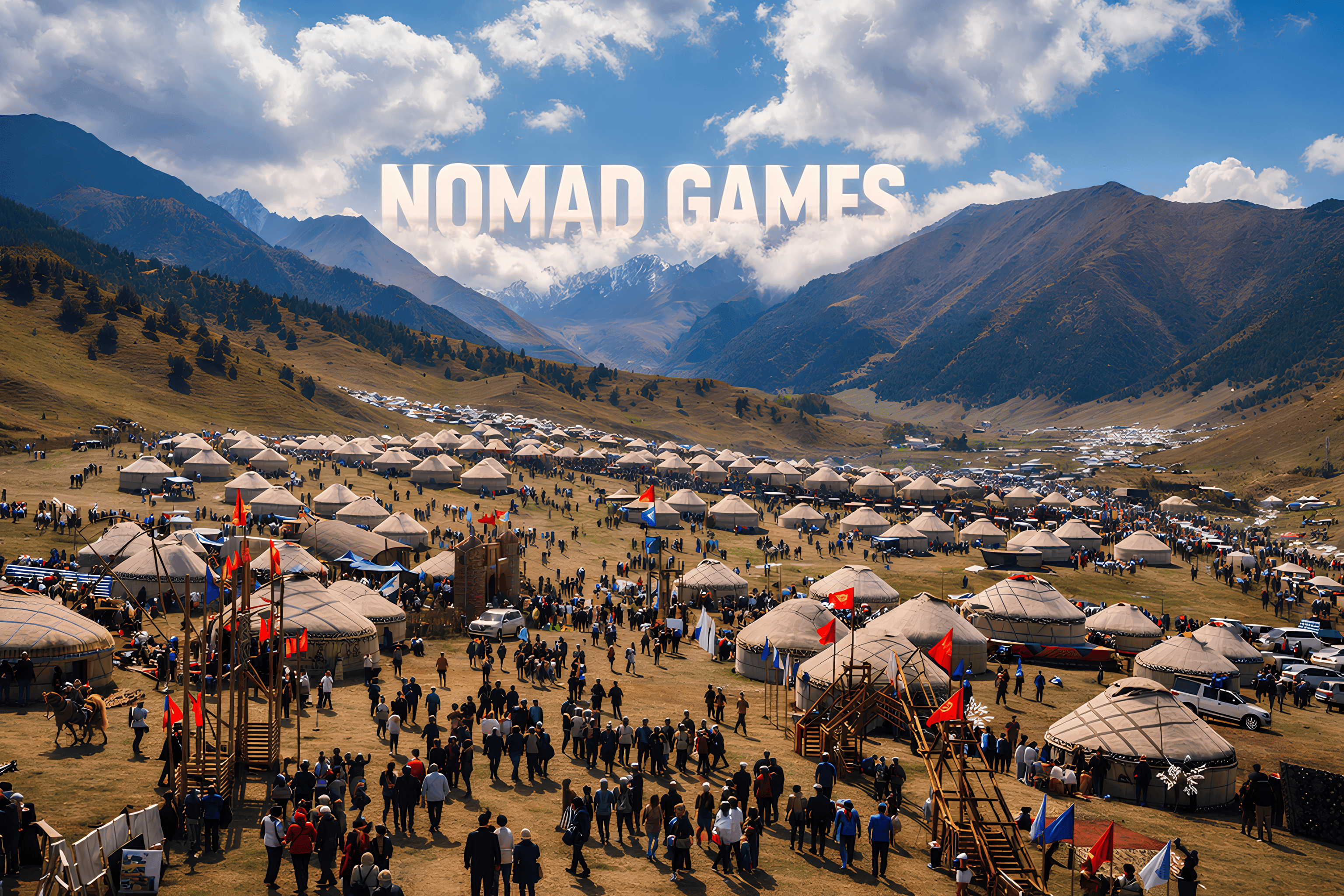
Unlike conventional sporting events, the World Nomad Games treats athletics as inseparable from culture. Each edition includes live performances of ancient epics, craft and cuisine showcases, traditional music, and a vast ethno-cultural village — turning the venue into a living representation of nomadic civilisation.
2012
Proposal by President Atambayev to create a festival preserving nomadic heritage globally
2014
Inaugural Games — Lake Issyk-Kul, 19 countries, 600 athletes, 10 disciplines
2016
28 nations, 1,200 athletes — international recognition begins to grow rapidly
2018
77 countries, 3,000+ participants — a genuinely global phenomenon
2023
89 nations — the largest edition, new disciplines from Mongolian & Bashkir traditions
Arts of the ancient warrior
The World Nomad Games features over 37 traditional disciplines — each one a window into the values, skills, and way of life that nomadic peoples developed over centuries. What unites them is the idea that sport, for nomadic peoples, was never separate from survival, community, or identity.
Tap any row to expand the full description.
Kok-Boru
Kyrgyzstan · Kazakhstan · Central Asia
Two teams on horseback compete to carry a goat carcass (ulak) and place it in the opponent's goal (tai-kazan). One of the oldest and most contested sports in Central Asia, Kok-Boru demands extraordinary horsemanship, physical power, and team coordination. Players can reach speeds over 60 km/h while controlling their horse with their knees alone. It is considered the flagship sport of the World Nomad Games.
Mounted Archery
Across Eurasia — Hungary to Mongolia
Competitors fire arrows at stationary and moving targets while riding at full gallop, dressed in traditional nomadic attire. Mounted archery was the defining military skill of the Eurasian steppe — armies of mounted archers like the Mongols and Scythians were among the most feared in history. Today it is practised as a precise and highly technical sport, demanding absolute unity between rider and horse.
Salburun — Falconry & Eagle Hunting
Kyrgyzstan · Mongolia · Kazakhstan
Berkutchi (eagle hunters) demonstrate the ancient partnership between human and raptor — typically a golden eagle trained over years of patient work. In 2016, UNESCO inscribed nomadic falconry as Intangible Cultural Heritage. At the Games, berkutchi compete in speed, accuracy, and the quality of the bird-handler bond.
Alysh — Belt Wrestling
Kyrgyzstan · Turkic & Mongolian nations
In Alysh, both wrestlers grip each other's belt from the start and cannot release it. The goal is to throw the opponent onto their back — a sport of leverage, timing, and explosive strength. Variants of belt wrestling exist across nearly all nomadic cultures, from Scandinavian glima to Mongolian bökh.
Er Enish — Horseback Wrestling
Central Asia · Steppe Nations
Two riders on horseback attempt to unseat each other using grip and body weight, without dismounting voluntarily. Er Enish is a direct descendant of the mounted combat training practices of steppe warriors — it demands not just strength but an intimate feel for the horse beneath.
Toguz Korgool
Kyrgyzstan · Kazakhstan · Central Asia
An ancient mancala-style board game played with 162 stones across 18 pits. Toguz Korgool is a game of deep mathematical strategy — players must think several moves ahead while managing complex redistribution of stones. It has been played by nomadic peoples for over a thousand years.
Mas-Wrestling
Sakha Republic · Siberia · Northern nations
Two competitors sit facing each other with their feet braced against a board, both gripping a wooden stick. The goal is to pull the stick — or your opponent — across the line. Originating among the Yakut people of Siberia, Mas-Wrestling demands grip strength, core stability, and tactical leverage.
Ordo — Stone Target Game
Kyrgyzstan · Central Asia
Players knock target bones (ashy) out of a marked circle using a lead-weighted bone called a joro. The game requires exceptional precision — competitors must control spin, trajectory, and force across varying distances, reflecting the nomadic emphasis on hand-eye coordination developed through a life outdoors.
Where the games have been held
The World Nomad Games has been hosted primarily in Kyrgyzstan, with the shores of Lake Issyk-Kul serving as its spiritual home. The choice of venue is never arbitrary — each location is selected for its deep connection to nomadic history and its ability to host both the athletic and cultural dimensions simultaneously.
The World Nomad Games has been hosted primarily in Kyrgyzstan, with the shores of Lake Issyk-Kul serving as its spiritual home. The choice of venue is never arbitrary — each location is selected for its deep connection to nomadic history and its ability to host both the athletic and cultural dimensions simultaneously.
Kyrgyzstan
Cholpon-Ata · Lake Issyk-KulThe founding host and spiritual centre of the World Nomad Games. Lake Issyk-Kul — a vast alpine lake ringed by the Tian Shan mountains, warm enough never to freeze — is one of the most spectacular natural venues in the world. The nearby town of Cholpon-Ata has hosted every edition to date, with a permanent ethno-cultural village built on the lakeshore that grows larger with each Games.
Turkey
Bursa · İznik PlainIn 2022, Turkey hosted a special edition on the İznik Plain — a region with deep connections to Oghuz Turkic nomadic heritage. The setting, surrounded by ancient Byzantine and Ottoman history, created a unique atmosphere where multiple layers of nomadic influence converged. Turkey's edition expanded the Games' cultural programming significantly.
Kazakhstan
Astana RegionKazakhstan — the birthplace of the domesticated horse and home to one of the world's oldest nomadic traditions — is a natural future host. The vast open steppes of central Kazakhstan offer a landscape that is itself a living testament to nomadic civilisation. Kazakhstan has been one of the strongest participating nations at every edition.
89 nations
Global participation · 6 continentsThe 2023 edition drew delegations from 89 countries across six continents — making the World Nomad Games one of the most internationally diverse sporting and cultural events in the world. Participating nations include not only Central Asian cultures, but also European, African, American, and Southeast Asian countries whose populations carry nomadic heritage.
Scale & significance
The numbers tell part of the story. But the World Nomad Games is not primarily a story of scale — it is a story of survival. Each athlete who competes carries with them a tradition that might otherwise have faded. Each cultural delegation brings practices, languages, and knowledge systems that exist nowhere else on earth.
Over 60% of all competitive disciplines at the Games involve horses. This reflects the fundamental truth of nomadic civilisation — the horse was not just transport, but the foundation of economy, warfare, migration, and culture across the entire Eurasian steppe.
The ethno-cultural village at each Games is one of the world's largest living museums — hundreds of traditional yurts and dwellings from dozens of nations, each decorated and inhabited in the authentic style of their culture. Visitors can move between centuries and continents in a single afternoon.
The Epic of Manas — the Kyrgyz national epic, estimated at over 500,000 lines and roughly 20 times longer than Homer's Odyssey — is performed live at every Games by manaschi (professional reciters). It is one of the longest oral epic traditions still practised in the world.
Multiple sports and traditions featured at the Games have received UNESCO Intangible Cultural Heritage status, including falconry, traditional horsemanship games, and felt-making. The Games are now an important mechanism for the international recognition and protection of nomadic knowledge systems.
The Games include competitive categories in traditional arts, music, cuisine, and craft — not as sideshows but as full programmes with their own judging, medals, and international participation. This makes the World Nomad Games the only event of its kind to treat nomadic culture as a complete civilisational expression.
Kok-Boru players reach speeds exceeding 60 km/h while controlling their horses with their knees and gripping a 30 kg ulak with one hand. The physical demands of nomadic sports rival the most intense disciplines in any international competition.
The nomad does not wander aimlessly — he moves with purpose, guided by the stars, the wind, and the memory of his ancestors.
The World Nomad Games is more than a sporting event. It is an act of cultural preservation — a declaration that the traditions of nomadic peoples are not museum pieces but living practices, still capable of inspiring, connecting, and competing at the highest level.
In a world of increasing homogenisation, the Games offer something rare: a space where diversity is not just celebrated but actively defended. Where ancient knowledge is treated as equal in value to modern technique. Where the horse, the eagle, and the open sky still matter.
The steppe is not empty. It is full of history — and the World Nomad Games is its voice.